Wednesday, October 7, 2020

10/6 Ashlynn Yvaine

     Discussing the idea of traditionalism versus avant-garde as that applies to catholicism in class was really eye opening for me. My father was raised in a catholic household however my mother was raised in a southern baptist church. Under my mother's lead the family has attended various types of christian services but never catholic. 

    Several years ago when my paternal grandmother passed away I attended my first catholic function, her funeral. After experiencing the varying degrees of welcome from various other denominations, this service was a shock. It was a beautiful ceremony, but my sisters and I along with various other cousins and guests were not invited to take part in several "rituals" including communion.

    It was jarring. In my perspective to be at once grieving for the loss of my grandmother and at the same time being forcefully alienated from the service which was meant to be a pathway for saying goodbye to her, it felt unchristian. However, I'm sure for many catholic traditionalists if we had been invited to partake they would see it as completely unheard of.

    It's a very strange line to walk but I think that looking at this conflict through our theorists might help me understand a little more.


10/8 Pre Class Blog -Jean Lyotard and Zoom Theater

 “Photography did not appear as a challenge to paint from the outside, any more that industrial cinema did to narrative literature. The former was only putting the final touch to the program of ordering the visible elevation by the quattrocento; while the latter was the last step in found off diachronous as an organic whole, which had been the ideal of the great novels of education since the eighteenth century. That the mechanical and industrial should appear as substitutes for hand or craft was not in itself a disaster- expecti if one believes that art is in its essence the expression of an individuality of a genius assisted by an elite craftsmanship.”( Lyotard, pg. 40)


This quote reminded of a discussion that has been ongoing in my history of theatre class. Currently, we have been discussing the relevance of theater in our current quarantine times. The theater has been shut down for the last couple of months and will continue to be shut down at least till the end of the year. Many companies (as well as our own theater department) have resorted to zoom productions, where actors are able to perform plays in the comfort of their own homes. While it is not the same as live theater, it has filled a void form many performers. Within this debate, many have argued that it is not safe for theaters to open and that it is now time for theater to be over with. “No one will want to come to the theater anymore because of its safety issues. Our current technological advances have made theater, in many people's opinions void and unimportant. In my opinion though, just as Lyotard talks about how advances in technology in the early 20th century didn’t replace the art of the past, I feel like the same will happen now. The theater will never be replaced. It could be altered or modified in some way, but there will always be a crowd of people who want to sit and have a lived experience with others.


Eclecticism

Eclecticism in online spaces is especially highlighted by the phenomenon of online blackface. While people aren’t explicitly painting their faces black online, the mannerisms they affect in order to appeal to others online are clearly attempting to imitate stereotypical African American speech patterns. The strangest part of it all is that they only do this when they’re trying to be funny, and in posts where they are more serious (or, at least, not trying to make a joke), the “blaccent” disappears. Along with using copious amounts of AAVE in joke posts, this may also be coupled with the usage of memes or gifs depicting black people. Now, I don’t know the specific statistics of meme usage, but anecdotally, I am sure that most of the reaction images I have seen online feature black people. It could be argued that the humor doesn’t come from blackness, but if that were true, then why isn’t there more equal representation of other races in commonly used memes? It’s almost like a continuation of minstrelsy, except most of the people doing it don’t intend to be racist. The lack of knowledge of the origins of popular online slang causes people to credit these words to whatever overwhelmingly white community they discovered it in rather than their true originators, African Americans. Black people have said this dispersal of AAVE in online communities has made it hard to tell who is black and who is just trying to sound black, though it also becomes incredibly apparent that someone is not if their usage becomes egregious. It’s especially bad when brands try to use it:


Notice how the Pop-Tarts account credited teens with the language. Instead of AAVE being seen as an integral part of African American culture, it is now just the way annoying teenagers online speak. The only way to combat this is by spreading awareness and teaching history, which many activists online have been trying to do. Unfortunately, the proliferation of AAVE online is just one way black culture has been appropriated and repackaged to be palatable to non-black audiences.

10/6 Post-Class blog

For immigrants, tradition is sometimes the only thing keeping them tied to their history. First-generation immigrants often have never been to the country their parents are from, and their parents try to keep cultural traditions alive in them despite the large disconnect the children may feel. While I hardly know the language my parents speak, my connection to my cultural identity largely comes from the traditions they have shared with me. It helps that a large portion of my family moved to a part of America with a strong Filipino community, and, growing up, I was often submerged in Filipino culture despite hardly remembering what it was like in the Philippines. Still, I am missing my parent's language, and that is already a large part of their culture that was never passed down to me.

As immigrant children start having families of their own, and their children have their own families, and their children have their own families, and so on, the ties to the homeland quickly fade. I’ve spoken to other Filipinos who are third or fourth generation immigrants, who’s families came to America much earlier than mine, and their attachment to Filipino-ness is tenuous at best. Their parents don’t know Filipino and have never been to the Philippines, and the fact that they are Filipino is more of a fun piece of trivia than an important part of their identity.

On a micro-level, this is demonstrative of how quickly history can fade as time continues, which emphasizes the importance of having people who will keep that memory alive. This holds especially true for indigenous cultures who have very few people left to keep propagating their way of life. Indigenous cultures have so much to teach us about how to live sustainable lifestyles, yet they are not valued in our so-called “modern” society. When we let these cultures die, we are also letting an important part of human history die with them.

Tuesday, October 6, 2020

Evie 10/6

 Through his writing, you can tell that Jurgen Habermas clearly has a nostalgia for things in the past. Today’s discussion on “traditionalism” versus “avert-gardism” connects to this longing. When I think of a tradition, I think of something that is repetitive and communal. These two descriptions both foster a feeling of comfort. To illustrate, when something is done many times, it feels stable. Likewise, when something is done with a community, feelings of security arise. Traditionalism is established and predictable due to its repetitive and communal nature. 

In contrast, avert-garde is the idea of creating a new way to shock the audience. The playful nature of this concept is far from comfortable. Habermas writes “Modernity revolts against the normalizing functions of tradition; modernity lives on the experience of rebelling against all that is normative” (p. 100). Although modernity and the concept of avert-garde are notably groundbreaking, we are missing a sense of dependability. This lack of consistency can lead to a longing for the comfort of tradition. Therefore, Habermas’ nostalgia is not surprising.

I especially enjoyed our discussion at the beginning of class of the public sphere. The public sphere is a place where intellectuals, or people in general, are able to go to have a conversation about big ideas. Such big ideas include culture, art, politics, etc. What I thought was most interesting is that social media is today’s alternative to the public sphere. Social media has transcended all boundaries of communication. I can be sitting in my apartment in Winter Park, Florida and potentially connect with anyone in the world and start an intellectual conversation. This access to mass communication has created several social media movements, like the Me Too Movement. This movement gave, and still gives, people the platform to discuss sexual abuse and harassment with those around the world. This public discourse shows victims that they are not alone and that they are heard. The public sphere is truly an incredible concept. 


Monday, October 5, 2020

10/6 Pre Class

This week's reading from Habermas gave a very clear insight into some of the identities of where a lot of the modernist culture derives from. We got a picture of the influencers and theorists from the time. After each reading, it is quite interesting to understand and analyze the intertextuality amongst all of our authors and theorists. The pieces are starting to connect with the framework being set up from a cultural aspect. Specifically, this week, the concept of aesthetic project and theory was mentioned and this set up the style and form of media delivery and the methods on how culture was perceived and shaped. The Enlightenment shaped culture and society in ways that are still impacting us today merely through the ripple effect.  Habermas had mentioned the surrealists and the effects they have and will have on future cultural norms, as Habermas says, “Communication processes need a cultural tradition covering all spheres - cognitive, moral-practical and expressive… The surrealist revolt would have replaced only one abstraction” (Habermas, 1981, p. 105). Below, I have attached a series of highly important quotes that will later be quite effective for analysis of further topics discussed in the course. These quotes are what I believe are important concepts and theories moving forward. I have now been slowly shifting my perspective with analyzing the past and using those thoughts to further predict and understand how the past will shape the future from today and so on. 

"With varying content, the term 'modern' again and expresses the consciousness of an epoch that relates itself to the past of antiquity, in order to view itself as the result of a transition from the old to the new" (Habermas, 1981, p. 98). 

"Specifically, the idea of being 'modern' by looking back to the ancients changed with the belief, inspired by modern science, in the infinite progress of knowledge and in the infinite advance towards social and moral betterment" (Habermas, 1981, p. 99). 

"Drawing upon the spirit of surrealism, Walter Benjamin constructs the relationship of modernity to history in what I would call a post-historicist attitude. He reminds us of the self-understanding of the French Revolution: 'The Revolution cited ancient Rome, just as fashion cites an antiquated dress. Fashion has a scent for what is current, whenever this moves within the thicket of what was once.' This is Benjamin's concept of the Jetzeit, of the present as a moment of revelation; a time in which splinters of a messianic presence are enmeshed" (Habermas, 1981, p. 100).  

10/1 Post Class

 Walter Benjamin makes truly incredible remarks on the age of reproduction that coincides with how media texts such as art can get mechanically reproduced in such an efficient way. This will have an everlasting effect with how media is delivered. We see in today's world how easy it is to be mislead and how much information is getting pushed out of many media outlets. It can be real news or fake news, but this mechanically produced content Benjamin discusses is all connected with the westernized form of government and capitalism. I am a firm believer that Marx may not be entirely wrong with his beliefs as Benjamin discussed. The idea of a capitalistic society is something I have trouble with, but I do not condone a communist environment. It is truly difficult to find that sweet spot of being able to incorporate social accountability, while still having an open-ended free market. These theorists have demonstrated the unique analysis of looking to the future by analyzing the past and framing their world in such a way that they can have a rough idea of future outcomes. Having this mindset and understanding the framework from an array of authors gives us so much context for how everything in the world from a social, political, and economic standpoint came to be. Below I have included two quotes that I truly admire and give so much support to how I believe the world is shaped in present day. 

“Even the most perfect reproduction of a work of art is lacking in one element: its presence in time in space, it’s unique existence at the place where it happens to be. The unique existence of the work of art determine the history to which it was subject throughout the time of its existence. This includes the changes which it may have suffered in physical condition over the years as well as the various changes in its ownership. The traces of the first can be revealed only by chemical or physical analysis which it is impossible to perform on a reproduction; changes of ownership are subject to a tradition which must be traced from the situation of the original” (Benjamin, 1969, p. 38-9). 

When Marx under took his critique of the capitalistic motive production, this mode was in its infancy. Marks directed his efforts in such a way as to give them prognostic value. He went back to the basic conditions underline capitalistic production and through his presentation showed what could be expected of capitalism in the future. The result was that one could expect it not only to exploit the proletariat with increasing intensity, but ultimately to create conditions which would make it possible to abolish capitalism itself” (Benjamin, 1969, p. 37). 

Sunday, October 4, 2020

10/1 Post-class

“The presence of the original is the prerequisite to the concept of authenticity”

Of the many plotlines happening in Naoki Urasawa and Takashi Nagasaki’s Billy Bat, one of the major ones is main character Kevin Yamagata’s concern that he may have stolen the main character in his comic, the eponymous Billy Bat, from an image he saw while he served for America in Japan. Due to this fear, he returns to Japan to get permission to use the character from its original creator, only to learn that the original creator doesn’t particularly care. In this scene, the old comic artist explains to Kevin why he isn’t concerned:


“Where did we learn to draw this cup?” he asks Kevin.

“Well… we copied someone else…” Kevin replies.

Later on, we learn that the design for Billy Bat didn’t even originate from that, but rather, an old cave painting of a bat that the comic artist saw. The one Kevin thought was the original was also merely a copy, and the cave painting that inspired it was merely a copy of what that artist saw in real life as well. Kevin’s concern with artistic integrity battling with his fear of financial repercussions is representative of the plight of the artist in modern society. The political imperative of art comes from many axes: Kevin needs to make a living, which already is changing his artistic output from what it would be if that imperative was not there. In addition to the financial aspect, he butts heads with his editors over where the plotline should go, with the editors insisting the Soviets be the true masterminds while Kevin finds the explanation unsatisfying. The political agenda of the ruling class further alienates the artist from something that should be so personal to them. Art does not belong to the creator, but to the reasons they have to make the art. Co-author Urasawa feels this pressure in real-life too:

I believe that if there are any signs that people would like to read [my comics], I’m sure they could be translated into English. But I do have a slight concern with Billy Bat… I’m not naming names, but major animation or film studios could take offence, or maybe draw some non-existent similarities between my work and their work, so that’s a slight concern…

Urasawa is all too familiar with the very Western concern of copyright and originality, knowing that his works are unable to reach a wider audience because of it. Rather than taking the risk of big companies such as Disney or Warner Bros. filing a lawsuit against his work, he would rather keep it untranslated. Even for a legendary comic artist such as himself, comics are not the most lucrative medium, and certainly not lucrative enough to battle those companies’ lawyers. Art is something that should not have these political and financial borders, but increasing corporate influence in art puts these borders in place.

10/1 Post Class Blog

 “The greater the decrease in social significance of an art form, the sharper the distinction between criticism and enjoyment by the public. The conventional is uncritically enjoyed, and the truly new is criticized with aversion”

  • Benjamin Mann


After reading this statement by Benjamin Mann a couple of times through, I believe that he has hit the nail on the head for our current media landscape. When conventional pieces of media are released, they are not as heavily criticized and just stated to be as part of a “genre,” which excuses their conventionalism. When something new is released, it can either face unwavering praise (which is still something good to be looked for) or be slandered for trying something new. For example, country music over the last couple of years has been very mentionable within its own music tone, subject matter, and vernacular use. Though many will criticize the country because of its substandard style, many people still enjoy it because of that familiarity. There are not many country songs that are released that challenge or have much social significance. 


This quote is also very reflective for me of the current film industry that we are dealing with. Disney the last couple of years has been releasing live-action remakes of their classic animated films. After these films are released in theaters, they make hundreds of millions to billions of dollars. The general public will go to see these films without thinking the true implications of setting them and give Disney that money. In essence, these live-action remakes have taken what used to be art (i.e the old animated Disney films) and made them into cash-grabs that make no effort to differ from their animated counterparts. In some sense, the tide is turning with these remakes. The new Mulan, which was released on Disney+ in early September, has received much backlash due to its lack of energy, passion, and cultural insensitivity. However, the Mulan remake did try to change the original animated tale, which led to many disliking it purely for that reason.


Jane Denson, 10/1

        After our class discussion of Walter Benjamin, I would argue that I have a better understanding of cultural theory as we know it and further study it. His analysis of mechanical reproduction seeping its way into other industries and areas of life was perhaps what struck me the most. Reading his work for the second time, I feel as though his dissection of the roles that photography and cinematography play in mass reproduction and imitation was rather enlightening of the bigger picture of Postmodernity. In his text, he essentially insinuates that this phenomenon can feature a political charge and must not be observed with an absent mind, which points to the notion that we should not be consuming mass reproduction without thinking critically of it and what it offers beneath the surface.
        
        As someone who has a deep passion for film, Benjamin's observations and theoretical insight into the world of cinema have made me much more aware of the texts I engage with. Lately, I seem to always look for elements of foreshadowing, symbolism, character tropes, etc. whenever I witness any film. It actually has become a fun activity for me, especially with horror works in particular. Speaking of the horror genre, I believe that there is a correlation to both Benjamin's ideas and our class' collective perspective on the images we viewed. In film, it becomes clear that in (mainly) the horror genre, reproduction and the notion of authenticity manifest through sequels. If you look at any slasher franchise, many people would go as far to say that sequels put them into an early grave. This likely stems from the following movies either cheapening the authenticity of the original or damaging what made the original so great in the first place. Not only that, but the debate regarding this topic is even more polarizing when it comes to remakes, which are argued to completely undercut the authenticity of the original film.

        The final piece of Benjamin's writing that I want to touch on from last class is this quote: “[the camera] permits the audience to take the position of the critic, without experiencing any contact with the actor” (Benjamin, 1935, p. 42). Here, I feel that it is important to mention that this implies that the audience is taking on the gaze of the camera when they view a film or televised program. It is this idea that helps us recognize and grapple with the notion of voyeurism, as well as how it infiltrates the cinematic realm, since it appears as though a majority of consumers of these types of text do not realize what the camera is actually accomplishing. I know that from my studies of films from the 1920s-1940s, voyeurism, or the (sexualized) objectification and observation of a certain person, social group, or thing, was a central aspect of most, if not, all of them.


10/1 Ashlynn Yvaine

I think the question of what good art is and whether it should be original is a very interesting conundrum. On one hand my creative instinct tells me to rebel against every other narrative and create only shiny new stories. The other part of me yearns to recreate the classic but just in a new way, maybe because it is just the way I originally felt them in my brain and I want to represent to others like me that they exist.

Many of the creative writing classes which I have taken have advised that nothing is truly original, every story is based off of the same characteristics that you would find in every other story from the beginning of history. Instead of being completely original we are supposed to just find our original interpretation. Even my friend's who are actors have received the advice to "know who to steal from" when it comes to their acting techniques and styles. 

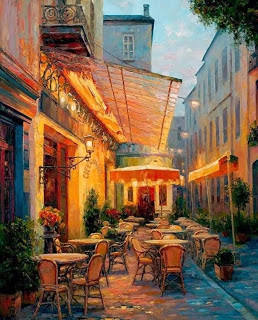
These bits and pieces of unoriginal content put together to create new art is a noble enough cause in my opinion. However, there is something to be said of the genuine quality of the original when the express purpose of the new art is to perfectly copy the first piece. An artist recreated a Van Gogh piece realistically and was faced with massive backlash. AlthoughVan Gogh was not entirely original, many artists have painted French cafe's, it was the way in which he painted that was the allure of the work. For another artist to paint the same scene but with more technical scene and a realistic style, it removed all of the attraction of the previous piece. A realistic style is something that we can see with our own eyes while the eye of Van Gogh is something we can only experience through his artwork.

An artist should know how to steal, take the idea of painting a cafe from somebody else, however it is the original lens that you bring to the table which separates it from corporate mass production and creates the special atmosphere of good art.

Van Gogh


Haixia Liu

Thursday, October 1, 2020

Abbey- 10/1

 “Secondly, technical reproduction can put the copy of the original into situations which would be out of reach for the original itself.” (Durham & Kellner 39)


    During our class discussion, this quote that we talked about really stood out to me. I was born in 2001, so as I have grown, I have been able to see how the media has evolved. As I grew up, I always had access to different forms of media and could experience how fast and far information can travel via media platforms. Through this experience, I have been able to see technical reproductions of art in multiple forms that I would have otherwise not seen if not for the technological advancements in the media. A current example of the media providing us a “copy of the original” that comes to mind is the 2020 presidential race. The presidential debates are being live streamed by multiple providers via video. This allows for the United States’ people to see a “copy” of the actual debates if they can not be there in person. The people that can not be there to witness the debates in person are able to view the debates from their homes with the help of technical reproduction. This is important because years ago when media usage was limited the majority of the United States would rely on secondary sources for their information about potential United States’ Presidents, meaning they would not get the opportunity to hear a candidate actually speak about what they stood for. Film is the media is a great form of communication and can bring experiences to people that they would have otherwise never gotten the opportunity to witness. While, the people watching the “copy” of the debate from their home might have a different experience from the people watching it in person, both parties are getting essentially the same information. Videography in the media provides us with world wide communication and access to pieces of art, events, speeches, etc. that we would have never been able to see without the newfound technology. I am interested if any of you have any personal experiences of being able to view “a copy of [an] original” that you otherwise would not have been able to without the current media technical reproduction?


Evie 10/1

Walter Benjamin expresses in The Work of Art in the Age of Mechanical Reproduction that “In principle, a work of art has always been reproducible” (p. 38). While art has always been reproducible, times have certainly changed. Before the 19th century, the replication of art was done by humans. The process was slow and not even close to being on a mass production scale. Today, art is replicated by means of machines. This new medium of replication allows for art to be copied exponentially. The issue with this innovation is that each time a work of art is copied it loses its authenticity. Benjamin argues that even the most perfect replication lacks its presence in time and space; an “authentic” print does not exist. In other words, the aura of the replicated piece is missing as nothing truly compares to the feelings and emotion tied to the original. 

The idea of printing and replication reminded me of my own experience with art. My family has a Salvador Dali print in our house with a fraction at the bottom corner. I was unaware of what the number meant until my mom informed me that the denominator indicates the edition size and the numerator indicates the number of each satisfactory print in the edition. Since editions are usually printed all at the same time, it seems impossible for the numerator to signify the actual printing sequence. However, since prints already lack value and authenticity, the number serves as a sort of tie to the original piece. The little fraction at the bottom of the print gives a sliver of authenticity back to the replica. Although the copy is one of many, it is still part of that one edition. In a way, a sense of uniqueness is tied to that number. I attached a photo of the print, it's a really cool piece!